

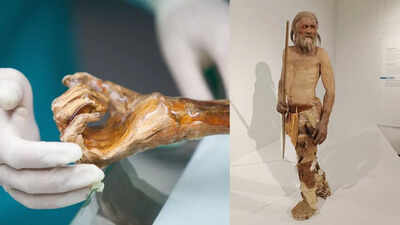
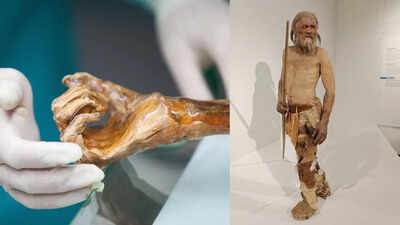
In a cold store in northern Italy, Ötzi the Iceman lies behind controlled glass and steel, kept at a steady chill that mimics the glacier that once sealed him away. He has been there since 1991, when hikers stumbled upon what appeared to be a recent body lodged in the melting ice of the Ötztal Alps. The assumption didn’t last long. What followed was the slow recognition of a man who had died more than five millennia earlier, preserved with an odd completeness that still feels slightly out of place in modern laboratory rooms. Skin, tattoos, fragments of clothing, and even traces of his last meals have all been mapped and re-examined. Now attention has shifted again, this time towards something less visible: the microscopic life still associated with him, and whether any of it is doing more than simply lingering.
5300-year-old Europe’s oldest mummy reveals microbial echoes inside
Ötzi’s remains have always carried a sense of suspended time. The cold slowed decay to a near halt, but it did not freeze the body into absolute stillness. Within that boundary between preservation and change, microbes became the latest focus, according to a study published in Springer Nature titled ‘The Iceman’s microbiome: unveiling millennia of microbial diversity and continuity’.What makes the current interest unusual is not just the presence of bacterial or fungal traces, but the possibility that some of them are not merely relics. They appear to have survived in forms that blur the line between ancient residue and ongoing biological activity, despite the expectation that such conditions would have long since shut everything down. To get closer to what was actually living on or within the mummy, researchers collected samples from across the body’s surface and from liquid trapped inside the preserved tissues. Old soil from the original discovery site was also brought back into the picture, along with data from earlier examinations of stomach and intestinal material.The difficulty lay in untangling what belonged to Ötzi’s original microbial community and what arrived later, either during recovery from the ice or through decades of museum handling. DNA and RNA sequencing offered a way to sort through that mixture, although even that yields blurred edges rather than clean lines. Some of what turned up pointed clearly towards ancient origins, fragments of microbial communities that appear to have been part of his body during life. Other signals looked far more recent, shaped by cold environments and modern exposure.
Microbial traces between dormancy, survival, and glacial transport
Among the more intriguing findings were yeasts that seem well suited to extreme cold. These organisms resemble strains found in polar regions, including Antarctica, and appear adapted to conditions that slow most biological processes almost to a standstill.Their presence raises a quiet possibility that they did not begin with the man himself, but instead arrived through the glacier environment that eventually encased him. In that sense, the ice did not simply preserve Ötzi; it may have introduced its own microbial passengers into the mix. Alongside these, there were microbial signatures that looked less altered, suggesting continuity stretching back much further. Whether that continuity represents dormant survival or intermittent revival is not easy to pin down. The data does not settle the question so much as leave it hanging.
Chemical preservation and the unexpected resilience of microbial life
There is another layer that complicates the picture. After discovery, parts of the body were treated with chemical agents intended to limit biological growth and stabilise preservation. One of these compounds, phenol, is toxic to many organisms. Yet some of the yeasts identified appear capable of breaking down phenol itself. That raises the uncomfortable thought that conservation efforts, designed to prevent activity, may have unintentionally favoured a small set of resilient microbes able to tolerate or even exploit the treatment. It is a narrow, technical detail, but it changes how the body is seen inside its refrigerated chamber. Not as sealed off, but as a site where chemistry and biology still overlap in unexpected ways.
When ancient preservation shows signs of slow biological turnover
Samples collected years apart show subtle differences. Certain cold-adapted species appear to have increased slightly over time, suggesting that whatever is present is not entirely static. Growth, if it is happening at all, would be extremely slow, measured in ways that do not resemble normal biological cycles. That idea sits awkwardly with the assumption that a 5,000-year-old body should be entirely biologically inactive. Yet the patterns hint at something less fixed. Not life in the usual sense of a thriving ecosystem, but not complete silence either.Ötzi continues to sit in that uneasy space between artefact and environment. The ice that once halted decay now functions as a kind of controlled habitat, and the microbes associated with him reflect both ancient biology and more recent intrusion. For now, the Iceman remains what he has always been: a preserved human, yes, but also something less straightforward, carrying traces of biological activity that refuse to fit neatly into the idea of a finished past.