

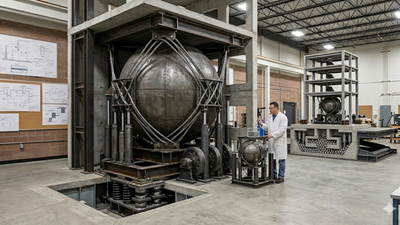
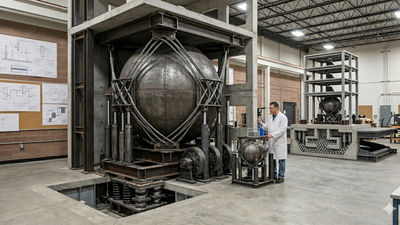
Earthquake-resistant technology may soon become simpler, cheaper and far more reliable thanks to a newly patented steel sphere cylinder developed by researchers at the University of Sharjah. The passive seismic damping device, created by civil engineering professor Moussa Leblouba, uses friction generated by steel balls inside a hollow cylinder to absorb earthquake vibrations in buildings, bridges and sensitive infrastructure without relying on electricity. Unlike traditional dampers that depend on sensors, fluids or power supplies, this mechanical shock absorber works through “pure physics”. Early laboratory tests showed an effective damping ratio of around 14%, raising hopes for stronger earthquake protection, lower maintenance costs and safer infrastructure during power outages.
How the steel sphere earthquake damper works
The new patent for the innovative seismic damping mechanism turns out to be rather simple in principle of operation. It comprises a hollow steel cylinder with solid steel balls inside as well as a shaft with short radial rods mounted in it. As reported by a research conducted at the University of Sharjah and referred to as ‘Assessing the performance of a novel granular material-based energy dissipation box damper for earthquake-resistant structures,’ once the earthquake starts shaking, the vibration movement drives the shaft through the packed steel balls, dissipating the vibration energy through friction.As noted by Professor Leblouba, this mechanism does not operate on any electrical power whatsoever. He pointed out, in interviews published via research announcements concerning the patent, that the mechanism functions purely physically, through friction.This becomes especially significant, taking into account the blackout phenomenon, which commonly occurs during strong earthquakes. Contemporary protection mechanisms are generally dependent on electronics and sensors, and hence become non-functional after losing electrical power, which does not happen in case of this mechanism. This US patent was issued in December 2025.
Why passive earthquake protection matters
There are many structures built long ago, which are exposed to seismic activity. Traditional dampers for these kinds of activities can be relatively costly to manufacture, repair and replace if necessary.However, the ball-bearing mechanism provides a cheaper option since it is modular and its components can be replaced. As per researchers’ claims, the system’s modules can be easily replaced without the need to replace the whole structure.In tests that were carried out in the University of Sharjah laboratory, the new system was able to absorb only about 14% of vibrational energy, which is not a big number. Nevertheless, structural engineers argue that some energy dissipation would help a lot in decreasing the load during an earthquake.Also, the ability to retrofit existing buildings is another great advantage of this invention. It would enable people living in developing countries to protect themselves from earthquakes by installing dampers in existing building structures without any reconstruction being done.
Potential uses beyond buildings and bridges
Though primarily designed for earthquake engineering, it was suggested that this new technology might also work on other vibration-sensitive applications. Some of these proposed applications are communication towers, industrial machinery, aeroplanes, ships, and scientific instruments.This next step will involve shake table tests on a larger scale, which will create a simulated seismic environment and will study the effect of the stronger earthquake forces on the invention, varying the sizes of the steel balls and rod formation for various structures.At present, the invention is at the testing stage, though some experts think that this new technology may prove to be valuable because of its simplicity, especially in disaster engineering. Technology that functions during such times is often the most valuable technology of all.