

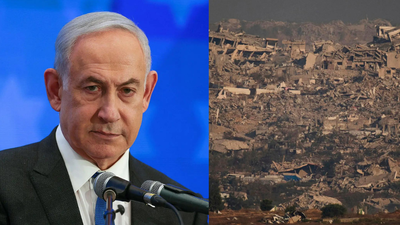
Israeli prime minister Benjamin Netanyahu appeared to acknowledge partial responsibility for the security failures that enabled Hamas to carry out its cross-border attack on October 7, 2023.However, he said accountability rested with “everyone” across all levels of the establishment and argued that the greater focus should be on the events that followed the assault rather than what led to it.
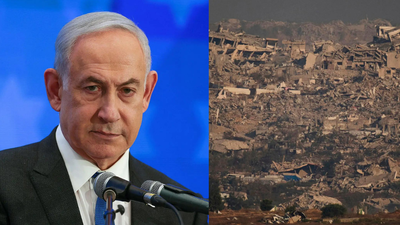
“Let’s look at the political echelon, military echelon, the security echelon. Let’s look down at everyone, and everybody bears some responsibility. Yeah, from the top, from the prime minister down,” Netanyahu said.During an interview with CBS, Netanyahu was asked why several officials responsible for security during the October 7 attack had resigned or been dismissed while he remained in office.Netanyahu responded that some officials had left because their terms had ended, while others “claimed they took responsibility, but it’s not clear what– what does that mean, you know? What is their responsibility?”Netanyahu reiterated his proposal for a politically appointed commission of inquiry into the October 7 attack, instead of establishing a state commission of inquiry, the country’s highest-level investigative mechanism, which he has so far declined to constitute.“But I think the real issue is, okay, that’s up to October 7th. What about since October 7th?” he continues. “[It] was clearly my responsibility to get Israel out of this horrible noose of death that the Iranians put on us. And we did, systematically, very resolutely, go [to] each one of these seven fronts, one after the other, and roll back the tide of terror,” he said.When asked about the growing perception that he is inclined toward conflict, Netanyahu said he had been regarded as “perhaps the most restrained prime minister in Israel’s history” until the October 7 Hamas attack, adding that perceptions changed following the assault.“I was conceived as being politically tough, but militarily very restrained,” he said of his more than a decade in power in which he had bucked frequent right-wing demands to declare full-on war on Hamas, and had cast such a war as unnecessary.Netanyahu said the October 7 attack marked a turning point in Israel’s security approach, claiming he viewed the assault not merely as an attack by Hamas but as part of a broader attempt by Iran-backed forces to “annihilate” Israel.The Israeli prime minister said he resolved at the start of the war to fundamentally change what he described as the coordinated threat posed by the “Iran axis.”Israel’s military campaign in Gaza Strip has killed more than 72,600 Palestinians, according to the territory’s Health Ministry, and triggered widespread destruction and mass displacement across the enclave.The ministry, which operates under the Hamas-led government, maintains detailed casualty records that are generally considered credible by UN agencies and independent experts, though it does not distinguish between civilians and militants.Israel launched the offensive following the October 7, 2023 attack, in which Hamas-led militants killed around 1,200 people, mostly civilians, and took 251 hostages.Although large-scale fighting has eased since a fragile ceasefire came into effect on October 10, Israeli strikes have continued to disrupt the truce. Both Israel and Hamas have accused each other of ceasefire violations, while Palestinians in Gaza continue to face severe daily hardships.