
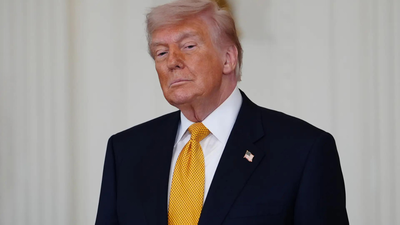
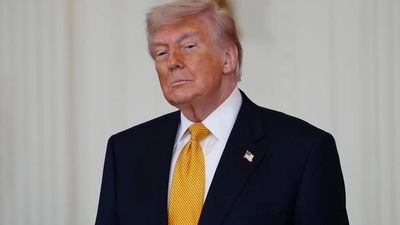
US President Donald Trump called on several Muslim-majority countries including Pakistan to sign the Abraham Accords as part of what he described as a historic reshaping of the Middle East.In a post on Truth Social, Trump said discussions with leaders from Saudi Arabia, the UAE, Qatar, Pakistan, Türkiye, Egypt, Jordan and Bahrain had convinced him that “it should be mandatory” for most of them to join the US-brokered diplomatic framework normalising ties with Israel. “The Abraham Accords have proven to be, for the Countries involved … a Financial, Economic, and Social BOOM,” Trump wrote, adding that the agreements could bring “true Power, Strength, and Peace to the Middle East for the first time in 5,000 years”.The remarks came amid continuing negotiations between Washington and Tehran over a possible ceasefire and broader regional settlement. According to Axios, Trump raised the issue during a high-level call with Arab and Muslim leaders on Saturday, reportedly catching several participants off guard, particularly Saudi Arabia, Qatar and Pakistan, none of which formally recognise Israel.Trump even floated the possibility of Iran eventually joining the accords if a final agreement is reached with Washington. “It would be an Honor to have them also be part of this unparalleled World Coalition,” he wrote.
What are the Abraham Accords?
The Abraham Accords are a series of agreements brokered by the United States in 2020 aimed at normalising relations between Israel and Arab states. The first accords were signed on September 15, 2020, between Israel and the United Arab Emirates and between Israel and Bahrain.The framework later expanded to include Morocco and Sudan, while Kazakhstan formally joined the grouping in 2025 despite already maintaining ties with Israel since the 1990s. The agreements marked the most significant Arab-Israeli diplomatic breakthrough since Israel’s peace treaties with Egypt in 1979 and Jordan in 1994.Named after the shared Abrahamic roots of Judaism, Islam and Christianity, the accords represented a major shift in regional diplomacy. Instead of linking recognition of Israel to a final resolution of the Palestinian issue, participating countries prioritised trade, investment, defence cooperation and strategic coordination, particularly against the backdrop of tensions with Iran.
Why Pakistan finds itself in a bind
For Pakistan, Trump’s push creates an especially delicate diplomatic challenge.Islamabad has long refused to recognise Israel, maintaining that any such move can only happen after the creation of an independent Palestinian state based on pre-1967 borders, with East Jerusalem as its capital. But Pakistan also maintains deep economic, military and political ties with Gulf monarchies that are increasingly engaging with Israel under US pressure.That contradiction has placed Islamabad in an uncomfortable position since the Abraham Accords were first signed in 2020. While close allies such as the UAE and Bahrain embraced normalisation, Pakistan stayed away, wary of domestic backlash and its longstanding support for the Palestinian cause.Pakistan’s dependence on Gulf financial assistance, remittances and security cooperation has only intensified the pressure. At the same time, any recognition of Israel risks provoking strong opposition from religious groups and sections of the political establishment at home.In 2025, Pakistan’s foreign minister Ishaq Dar firmly rejected speculation that Islamabad could join the accords.“We are not ready to recognise Israel until the two-state solution to the Palestine conflict is accepted,” Dar said during a press conference at the Foreign Office. “There is no change in our stated policy on the Palestine issue.”He added that signing the Abraham Accords would effectively amount to abandoning Pakistan’s longstanding demand for a Palestinian state with “Al-Quds Al-Sharif as its capital”.