


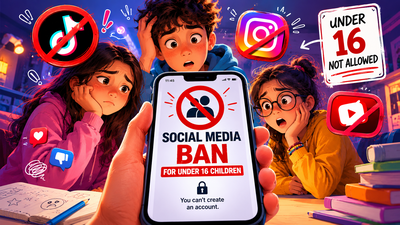
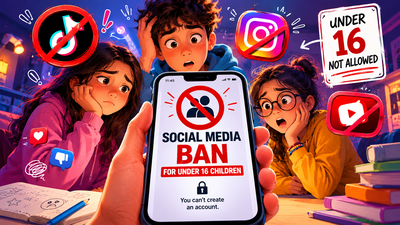
After Australia, Malaysia has also decided to keep children under 16 off social media platforms. The country has begun enforcing new rules that stop minors from opening social media accounts and require platforms to verify the age of existing users over the upcoming months.The rules, which came into effect on Monday, apply to social media services with at least 8 million users in the country, including Facebook, Instagram, TikTok and YouTube. Platforms must now put age-verification systems in place and prevent underage users from creating new accounts.According to Malaysia’s Communications and Multimedia Commission, existing users found to be younger than 16 will be given one month to download or transfer their content, such as photos and videos, before restrictions or other measures take effect. The verification process for current accounts will be introduced gradually over the next six months.
Malaysia’s new restrictions
Authorities said that the move is intended to reduce children’s exposure to harmful content, cyberbullying and features that encourage excessive time spent online. The regulator stressed that the policy is not designed to block children from using digital technology altogether, but to improve safety standards and tackle underage accounts and harmful material.Companies that fail to meet the new requirements could be fined up to $2.5 million, at the same time, no penalties will be imposed on parents if their children are able to get around the restrictions.The measures place Malaysia alongside a number of countries that have either introduced or proposed age-related controls for children’s use of social media. Australia, Brazil and Indonesia have already announced or implemented such requirements, while Britain, France, Spain, Denmark, Thailand and South Korea are considering similar policies.Technology firms have not yet outlined how they intend to comply with the regulations. Clara Koh, Meta’s director of public policy for Southeast Asia, previously warned that barring under-16s from social media could have the opposite effect by pushing teenagers towards less regulated online spaces.The debate over children’s online safety has intensified globally as governments face increasing calls to address concerns around mental health and digital wellbeing. In March, a U.S. jury awarded millions of dollars in damages in a case against Meta and YouTube that alleged platform design features contributed to harm suffered by a young user.
Off social media V on — What are parents saying
The new rules have prompted different reactions among Malaysian parents.For Kuala Lumpur residents Saravanan Ganasan and Jayaradha Veerasamy, the restrictions align with practices already in place at home. Their children, aged 12 and 15, are not allowed to use social media because the couple believes young people are not ready to handle its effects.“Exposure is what we fear,” Saravanan said. “The wrong kind of exposure will do damage to the mind.”The family keeps devices away from bedrooms, restricts screen use to shared spaces and does not allow their son to secure his phone with a password.Their son, Aadhavan Saravanan, 15, said unrestricted access could easily become a problem.“Social media is, like, a luxury and it’s not a necessity,” he said.According to the parents, spending less time online has encouraged their children to pursue other interests. Aadhavan spends time reading books in a backyard mango tree and fixing broken household appliances, while his sister enjoys cooking and crafts.“A lot of parents are very scared that children get bored,” Jayaradha said. “But boredom is actually very good because they start thinking out of the box.”
Others fear unintended consequences
Not everyone agrees with the government’s approach.Shaun Hew, who lives in Cheras, said social media can be useful for children when adults supervise their use. He said his 11-year-old son learns cooking through online platforms, while his 14-year-old daughter uses YouTube while preparing for examinations.Hew fears that cutting off access abruptly may encourage teenagers to seek alternative ways around internet restrictions.The policy has also sparked concerns among academics and privacy advocates. Benjamin Loh, a social science lecturer at Monash University in Malaysia, questioned the requirement for government identification as part of the age-verification process.“It is very much following the trend, but in a way that is raising alarms due to requiring a government ID for age verification,” said Loh.He argued that the collection of identification data could leave social media companies holding sensitive personal information without adequate protections. Loh also said the rules may create difficulties for stateless people, undocumented residents and individuals from marginalised groups, including LGBTQ+ communities, who rely on online anonymity.He further pointed to what he described as a loophole in the law, noting that parents face no consequences if they create accounts for their children.“This is a major gap that, unless regulators are willing to fix, will result in the law having little effect in stopping children from using social media,” he said.