


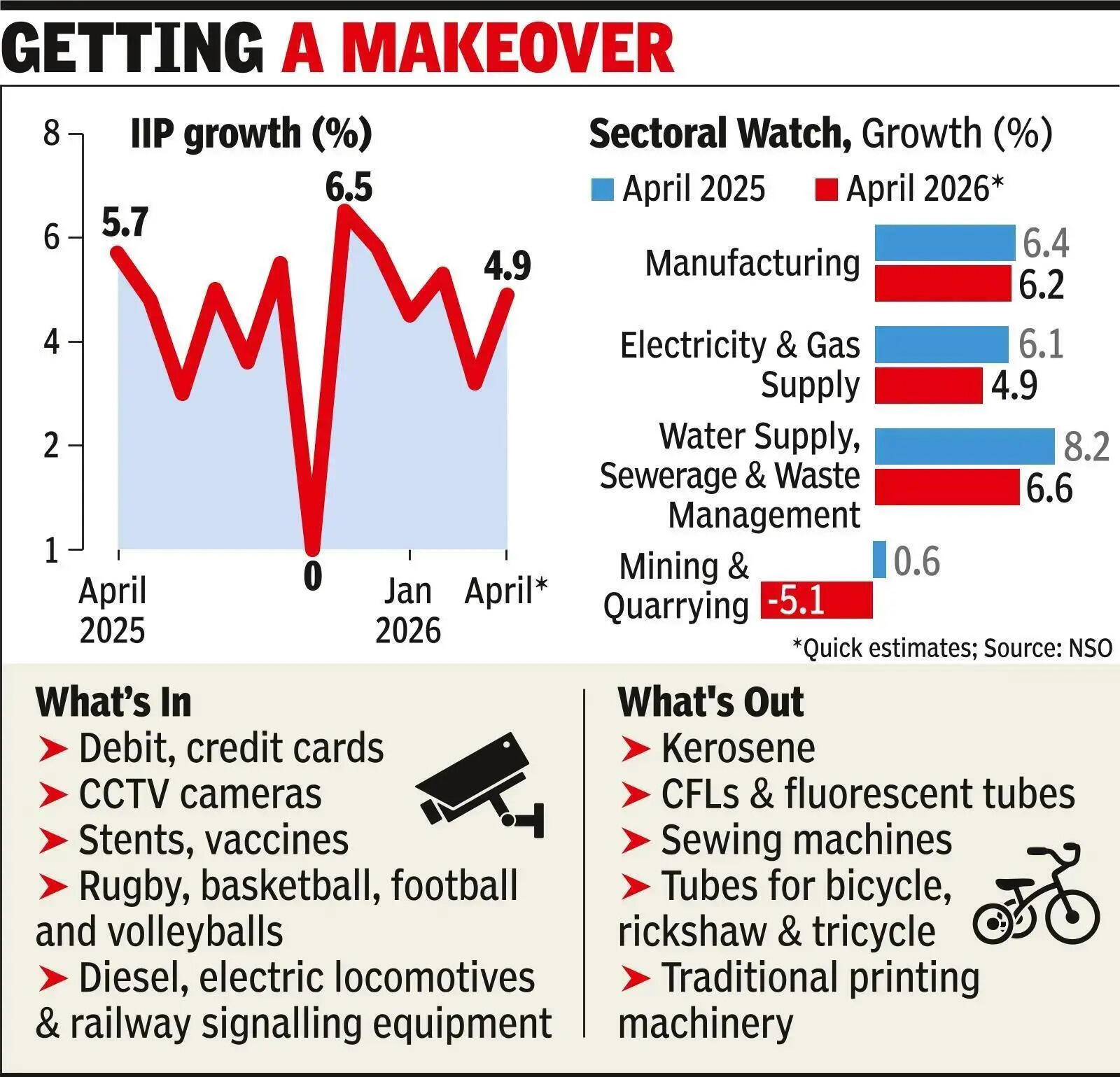
NEW DELHI: Industrial production growth slowed to 4.9% in April 2026 from 5.7% a year earlier on account of a contraction in mining and quarrying and slowdown in other sectors. The statistics ministry Monday released the new IIP series, with 2022-23 as the base year (from 2011-12), updating the methodology and broadening the coverage of the activity in the industrial sector.The new series now has four sub-sectors — mining (down 5.1% in April), manufacturing (showed 6.2% growth), electricity & gas supply (4.9%) and water supply, sewerage & waste management (6.6%). Manufacturing sector retains the highest weight (76.1% compared with 77.6% earlier) in the new series. However, sequentially, industrial output grew 4.9% in April, higher than 3.2% in March, driven by strong growth in manufacturing and electricity generation, belying the fear of an immediate negative impact of the West Asia crisis on economy.

“Industrial production could remain subdued in the months ahead. The larger risk, though, is rising costs (as) the energy supply shock has morphed into a price shock,” said Dipti Deshpande, principal economist at Crisil. Among use-based categories, as many as five of the six segments witnessed an uptick in their growth rates in April compared to March, barring primary goods, which largely reflects the tepid performance of the mining sector. Notably, capital goods output expanded by double digits (16%) for the sixth consecutive month, while infra/construction goods output rose by a 7.1% in the month, suggesting that construction and investment activity continues to remain strong. On the consumer front, durable goods grew 4.3%, while non-durables grew by 2.8%. “Consumer segments remain moderate and the drag from mining points to underlying frictions in resources linked sectors, reinforcing that the supply chain is not operating at full synchronisation. It suggests that firms are expanding output selectively,” said Arun Singh, chief economist at Dun & Brandstreet India.Within electricity and gas supply, the new series provides a break-up of electricity generated through renewable and non-renewable sources.