




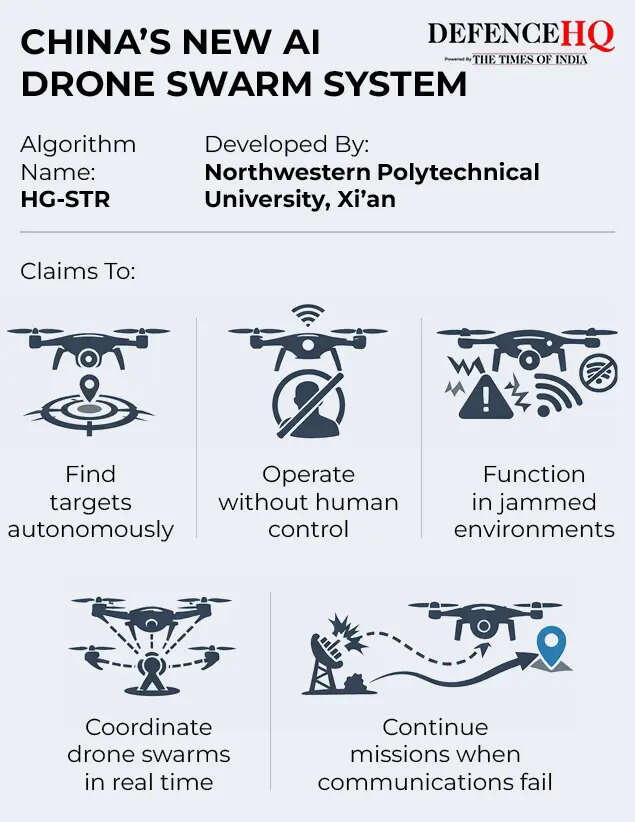
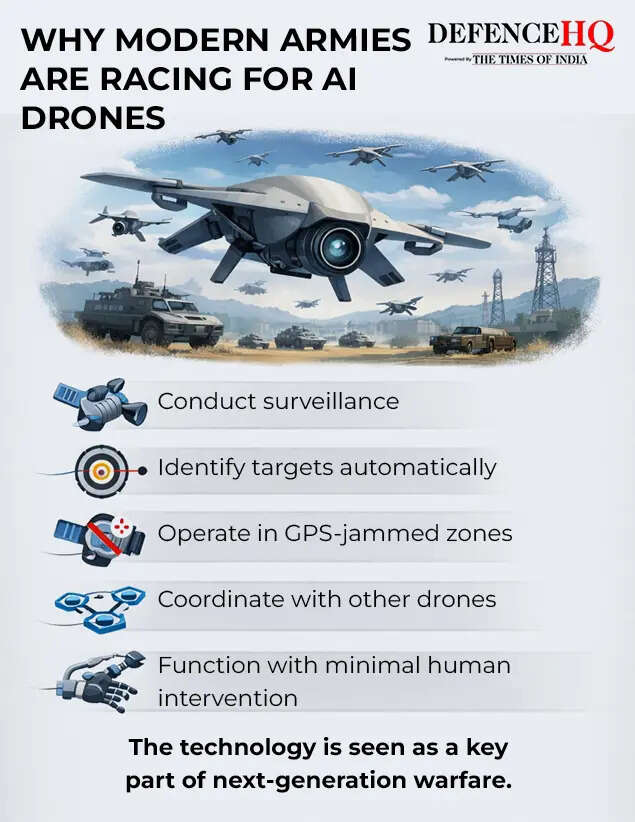
A Chinese research team has unveiled a new artificial intelligence algorithm that it claims could significantly advance autonomous drone warfare, enabling swarms of fixed-wing drones to independently locate and eliminate enemy targets even in heavily contested environments where communications are jammed and visibility is limited.According to a peer-reviewed paper published on May 19 in China’s aviation journal Acta Aeronautica et Astronautica Sinica, the algorithm — called HG-STR (Heterogeneous Graph Spatio-Temporal Reasoning) — achieved a 100 per cent target elimination rate in simulation tests.The development comes as militaries worldwide increasingly explore the use of autonomous drone swarms to conduct surveillance, reconnaissance and strike missions in future conflicts.

Designed for modern electronic Warfare
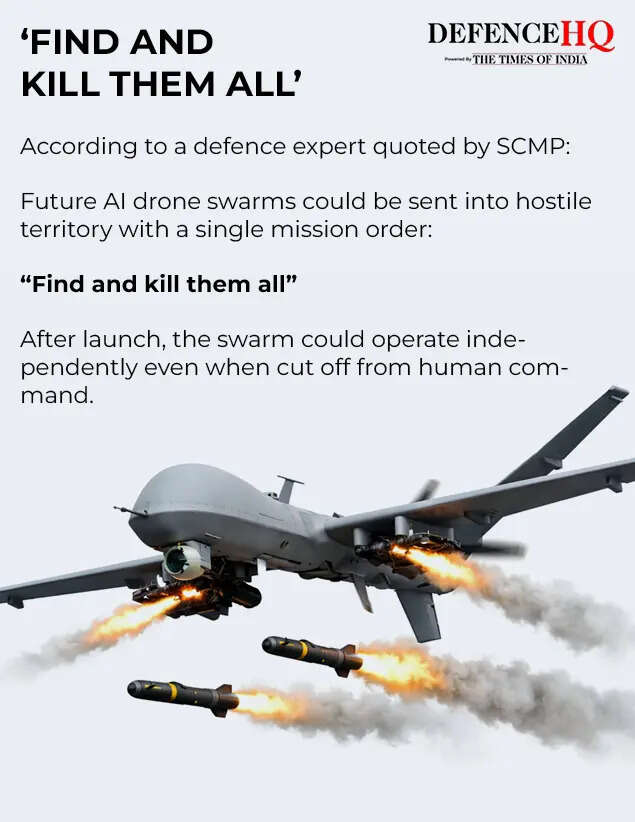
The research was led by Zhang Dong, an associate professor at the School of Astronautics at Northwestern Polytechnical University in Xi’an.As per South China Morning Post, the new algorithm is designed to overcome limitations of existing drone-control systems, which often struggle in dynamic battlefield conditions where communications are disrupted and enemy movements are unpredictable.Traditional systems typically process all battlefield information in a similar way, creating confusion when distinguishing between friendly forces, enemy targets and terrain features.The HG-STR system instead builds what researchers describe as a “heterogeneous graph”, assigning different categories and priorities to various battlefield elements.This allows drones to rapidly identify threats, coordinate with nearby teammates and make mission decisions without requiring constant human input.A Beijing-based defence expert, quoted by SCMP, said the technology points to a future where drone swarms could operate independently in high-risk combat zones after receiving only a final mission order to “find and kill” designated targets.“This technology suggests a future where swarms of drones could be sent into a high-risk, jammed environment, cut off from human command with a single final order: find and kill them all,” he said.
Faster decisions, greater autonomy
One of the key advantages highlighted by the researchers is speed.According to the paper, older optimisation methods can take several seconds to calculate battlefield decisions, potentially leaving drones vulnerable. Zhang wrote that during such delays, a drone could travel nearly 600 metres “blind”, creating serious risks in an electronic warfare environment.The HG-STR algorithm reportedly makes decisions in just 6.6 milliseconds.

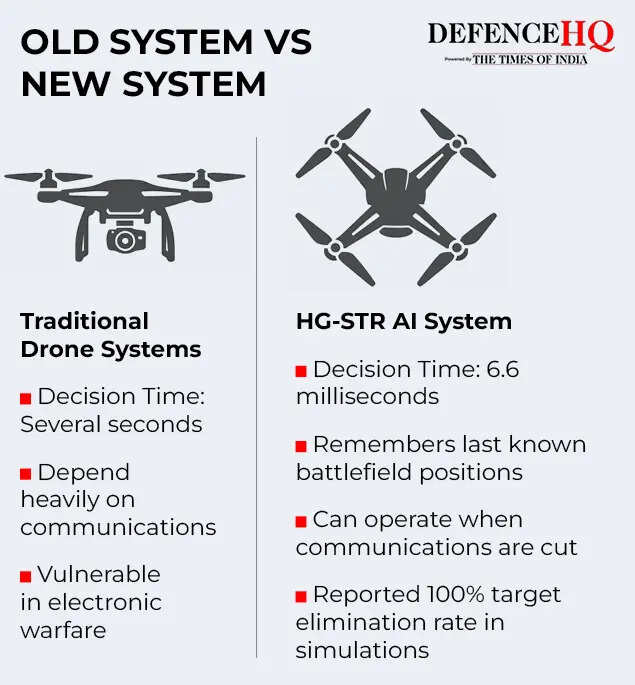
Researchers also equipped drones with a memory system known as a Gated Recurrent Unit (GRU), enabling them to continue operating when communication links are severed.The drones can retain information about the last known positions of allies and targets even when isolated.
Hierarchical decision-making system
The team also developed what it calls a hierarchical decision structure.

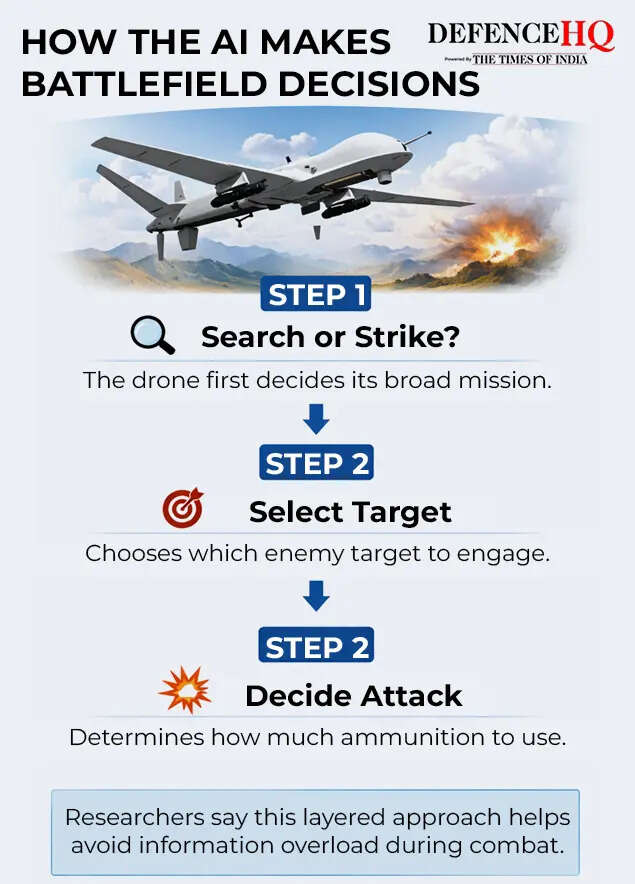
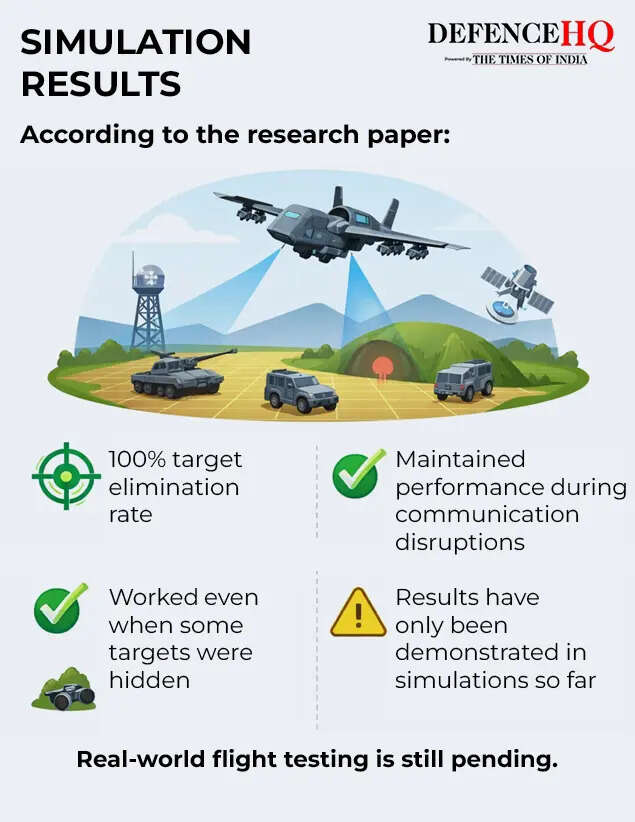
Instead of processing every battlefield variable simultaneously, drones first determine a broad objective such as whether to search or strike. They then select a specific target and finally decide how much ammunition to deploy.According to the researchers, breaking decisions into layers allows drones to operate more efficiently and avoid information overload during complex missions.Simulation tests showed the system maintained a 100 per cent kill rate even when communications were severely restricted and some targets were hidden from direct observation, reported SCMP.
Real-world testing planned
The researchers said future work will focus on deploying the algorithm on real airborne platforms with limited computing power and conducting flight tests outside laboratory conditions.“Future work will focus on exploring the lightweight deployment and real-flight verification of this algorithm on embedded airborne platforms with limited computing power,” the team wrote.The study was funded by China’s National Natural Science Foundation.The development reflects a broader global push toward autonomous military systems, with major powers increasingly investing in AI-driven drones capable of operating in contested environments with minimal human intervention.
While the Chinese team’s results have so far been demonstrated only in simulations, the research highlights how artificial intelligence is becoming a central component of next-generation warfare.