


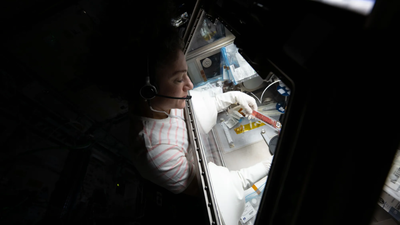
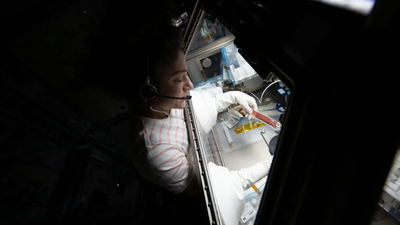
One of the key areas of scientific study in recent times includes the use of stem cell research in space. Scientists are conducting research to see how the human body is affected by microgravity, and the possibility of growing stem cells in space aboard the International Space Station (ISS) allows us to see how such cells react in conditions other than Earth’s gravitational pull, which could help understand better how cancer evolves, regenerate tissues and treat disease. NASA studies have shown that the growth of stem cells in microgravity can cause them to grow into shapes that resemble those found inside human bodies, which makes it possible to conduct medical experiments in space and develop cancer treatment techniques, among others.
Microgravity and stem cell behaviour in space
The forces of gravity affect the growth, division, and organisation of cells on Earth. However, in space, where there is less gravitational force acting on the organisms, researchers can study the behaviour of cells without any hindrance from the forces of gravity. As per NASA, the International Space Station acts as a laboratory to carry out observations of the biological processes under different conditions than those found on Earth.Now, the Hematopoietic Stem Cell Expansion in Space (InSPA-StemCellEX-H2) investigation is aiming to demonstrate large-scale production of blood stem cells for pharmaceutical and clinical use.In microgravity, “scientists get an unobstructed view of how cells behave under circumstances hidden by the forces of gravity here on Earth.” Cells are able to become various types of tissues, such as muscles, nerves, and blood cells, because of their ability to develop.
Stem cell research on the International Space Station (ISS)
The International Space Station (ISS) is an important facility used for biomedical research in space. Scientists send stem cell samples to be tested for their behaviour, growth, differentiation, and response to stress under microgravity conditions.Studies conducted by NASA revealed that stem cells cultivated in space were able to aggregate into 3D structures more readily than those cultivated under normal Earth conditions.According to NASA research abstracts, experiments conducted in space offer insight into the functioning of human cells in “the absence of gravity.”
How space stem cell research helps cancer treatment
One of the most successful avenues of study has been related to cancer treatments. The behaviour of cancerous cells in microgravity, as well as the use of stem cells developed in outer space, will give more insight into the understanding of cancer cell development.According to several studies conducted by the School of Cellular and Molecular Medicine, University of Bristol and Biomedical Sciences Building, University Walk, Bristol, UK, cancer cells exhibited more complicated structure formation while in outer space, which could help mimic tumour growth within the human body. This will allow for proper drug testing and the creation of new treatments.NASA researchers also point out that the microgravity environment is able to assist in “modelling disease progression in ways not possible on Earth.”
Regenerative medicine and disease treatment applications
Stem cells have great significance in regenerative medicine as they are capable of repairing and replacing damaged tissues. Researching these cells in space might lead to the creation of more effective treatments for heart diseases, neurodegenerative diseases, and immune deficiencies.It is suggested by NASA-funded studies that microgravity affects the specialisation process of stem cells. Scientists might be able to utilize the findings from this process to create treatments for regenerating damaged organs and chronic diseases.In fact, according to the Life Science Division at NASA, conducting research such as ‘The Effects of Microgravity on Stem Cell-BasedTissue Regeneration: Keratinocyte Differentiation in Wound Healing (STL)’ insinuates that spaceflight inhibited the migratory ability of microgravity-differentiated cultures, and also supports the hypothesis that the tissue regenerative potential of stem cells may be decreased during spaceflight. Such experiments in space contribute to advancing regenerative medicine and improving human health outcomes on Earth.The main benefit of performing research in space lies in the difference between the environments in which biologists conduct their studies. Since the force of gravity does not pull cells downwards, they are able to investigate biological processes in all directions.Conducting experiments in this way helps to overcome certain limitations in the area of biological sciences. At the same time, researchers are provided with an opportunity to observe the behaviour of living beings under conditions of long-term experimentation.As stated by NASA, the ISS acts as “a unique laboratory for scientific discoveries in the fields of biology, physics, and medicine.”
Future of stem cell research in space
The future of stem cell study in space seems to be promising. With each mission becoming more complex and advanced, scientists will obtain more data about how human cells operate in microgravity.“Microgravity in space is a far better environment to maintain the quality of the stem cells in their high-quality state during their growth.” The above statement comes from Dr Tobias Niederwieser, who is an assistant research professor at BioServe Space Technologies at the University of Colorado Boulder. Research done in this field can provide important advances in areas such as cancer treatment, tissue regeneration and personalised medicine. It might also give clues on how to treat age-related diseases and injuries.Although only at its beginnings, space stem cell study is an important milestone in the integration of two branches of knowledge for space science and medical advancement.Space stem cell research allows scientists to find answers to questions about human biology that cannot be answered here on Earth. Through the use of the International Space Station as a laboratory, doctors can study how human beings operate in a different environment and make discoveries in fields such as cancer growth, regenerative medicine and treatments.