


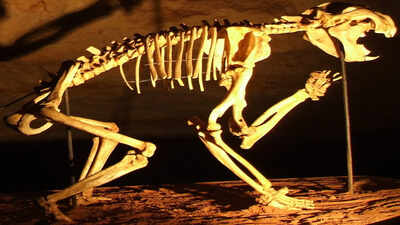
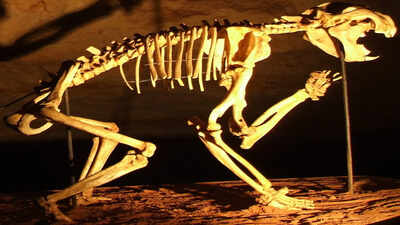
The experience of being on the Nullarbor Plain of southern Australia is one of stepping into another world. The area is known for its stark topography, with hardly any trees at all and a merciless desert sun which breaks down anything organic within a few weeks. But underneath the feet of the unsuspecting traveller are limestone caves telling a completely different tale.In 2002, a group of dedicated cave explorers was scanning this desolate landscape for hidden underground openings when they squeezed through a narrow fissure and dropped down onto a completely undisturbed cavern floor. Shining their headlamps into the pitch-black darkness, they expected to find ordinary rocks or seasonal sediment.Rather, the light rays from their torches revealed the almost perfect skeletal structure lying calmly in the dust. It quickly became apparent that the bone structure possessed some unique features, including an exceptionally sturdy structure and terrifyingly advanced jaws. The cavers had discovered, entirely by accident, the bones of a marsupial lion, which had been extinct on planet Earth for tens of thousands of years and was considered an absolute apex predator.The underground chambers hold unthinkably vast lengths of deep timeThe extraordinary condition of the bones caught the attention of the geologists straight away because organic structures do not usually last very long on the surface. This is according to an important geological research study, titled The antiquity of Nullarbor speleothems and implications for karst palaeoclimate archives.It is noted here that the geological past of the area is responsible for making a highly arid and stable underground ecosystem with absolutely no air movement and little penetration by water. The outside world, which experiences climatic and weather variations along with erosion, is totally sealed off from this environment.

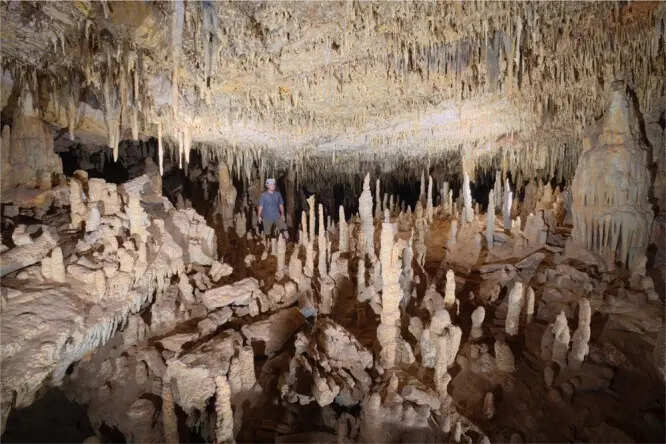
Explorers found an ancient marsupial lion skeleton in a Nullarbor Plain cave. This discovery offers a unique look at extinct life. The cave’s stable environment preserved the fossil for millions of years. Image Credit: The antiquity of Nullarbor speleothems and implications for karst palaeoclimate archives Fig 2
Using cutting-edge dating methods on the surrounding minerals, researchers found that these caves had not been touched at all for more than four million years. Such amazing geological stability is what allowed a delicate fossil skeleton of an ancient creature to rest completely exposed on bare ground, without turning into a pile of dust or becoming dislodged by scavengers.Unravelling the habitat of a long-extinct apex predatorThis discovery gave biologists a unique opportunity to study extinct ecosystems of the continent. As reported in a paper titled An arid-adapted middle Pleistocene vertebrate fauna from south-central Australia, in the scientific journal Nature, this discovery proved to be far more than just an interesting anomaly.The study details how the unique cave system managed to preserve entire communities of extinct megafauna, including several previously unknown species of giant tree-kangaroos. By analysing the beautifully preserved skeleton of the marsupial lion found inside this ecosystem, researchers were able to definitively study its bone density, predatory biting power, and climbing mechanics.Indeed, these underground caverns stand as a clear testament today, reminding us that Earth manages to keep the memory of itself hidden in the most unusual places. Although we stare at these seemingly deserted terrains and take them for granted in terms of their lack of life, there is an entire world of mystery lying dormant under their feet. They show that all it takes is a little curiosity to unlock amazing stories from times long gone by.It is a mind-blowing notion indeed to consider that while the people of today’s times have spent decades riding in their cars on the highway on the empty land, the remains of a fearsome prehistoric creature were lying still underneath them.