




NEW DELHI: Supreme Court seems split on the issue of bail and right to liberty, enshrined as a fundamental right. An SC bench Monday expressed “serious reservations” on the court’s verdict denying bail to Umar Khalid and Sharjeel Imam, saying it didn’t follow a larger bench judgment — which is “law of the land” and as per which bail should be granted in cases of long incarceration and delay in trial, even under UAPA and PMLA. A bench of Justices B V Nagarathna and Ujjal Bhuyan said it was “difficult to follow” the division-bench judgment in Delhi riots case, which contradicted the 2021 three-judge Najeeb case verdict, and expressed concern over “propriety of smaller benches progressively hollowing out the constitutional force of a larger bench decision without ever expressly disagreeing with it”. ‘Bail is the rule, jail the exception’ wasn’t just a slogan flowing from CrPC but a constitutional principle grounded on Art 21 & 22, the bench said.

Presumption Of Innocence Cornerstone Of Society: SC
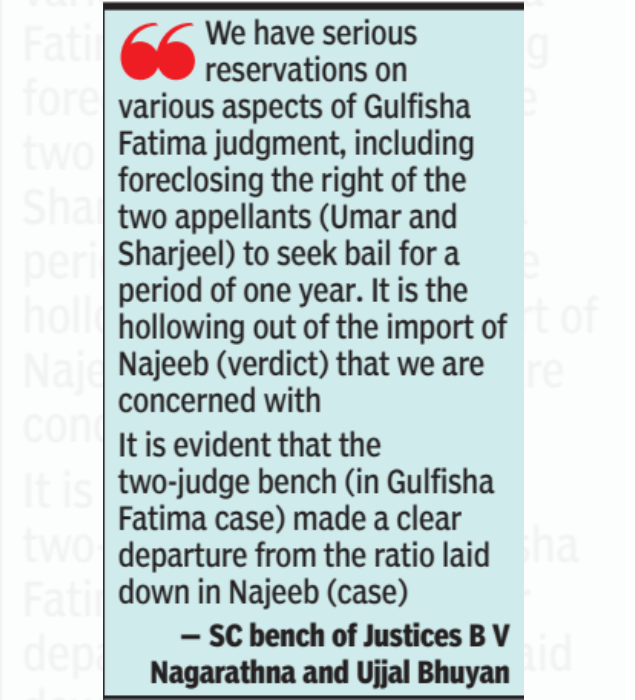
SC said presumption of innocence is the cornerstone of any civilised society governed by the rule of law. “Statutes may undoubtedly calibrate the manner in which that principle is applied, particularly in cases involving national security or terrorist offences for which the UAP Act is meant, but those cannot altogether invert the constitutional relationship between liberty and detention”. Analysing various verdicts passed by SC which followed Najeeb’s rulings, the bench said, “It is evident from a reading of the two judgments in Gurwinder Singh and Gulfisha Fatima (relating to Delhi riots case) that the two-judge bench has made a clear departure from the ratio laid down in the KA Najeeb (case). Judicial discipline and certainty demands that benches of smaller strength are mindful of decisions by larger benches and are bound to follow the same.” “If smaller benches are unable to agree with the ratio laid down by the larger bench then the proper and only course of action open is to make a reference to the Hon- ’ble CJI for placing the matter for consideration by a still larger bench. Being in a combination of two judges, we are bound by the ratio laid down by the three-judge bench in K A Najeeb. We say this and no more,” the bench said. It said the Najeeb case, where bail was granted to an alleged PFI member, is a binding law and cannot be diluted, circumvented, or disregarded by trial courts, high courts or even by benches of lower strength of this court. The bench said the ruling in the Najeeb case was never that mere passage of time automatically entitles the accused to bail under Sec 43-D (5) UAPA. “Instead, the larger bench recognised that where incarceration becomes unduly prolonged and the trial is unlikely to conclude within a reasonable time, the continued application of the section becomes constitutionally suspect given the mandate of Article 21. In that sense, Najeeb articulated a constitutional limitation on the operation of the statutory embargo of Section 43-D(5),” it said. While rejecting the bail plea of Khalid and Imam, SC had said “the finding in Najeeb (case) is properly situated as a constitutional safeguard to be invoked in appropriate cases,” and not for “universal application”. The bench said, “We have serious reservations on various aspects of the judgment in Gulfisha Fatima (case), including foreclosing the right of the two appellants to seek bail for a period of one year. The judgment in Gulfisha Fatima would have us believe that Najeeb is only a narrow and exceptional departure from Section 43-D(5) justified in extreme factual situations. It is this hollowing out of the import of the observations in Najeeb that we are concerned with.” It said reasoning first in Gurwinder and then in Gulfisha Fatima, “appears to proceed against something invented and then destroyed”. The court said the emphasis in the Najeeb judgment was constitutional in nature and “it was directed towards preventing Section 43-D(5) from overpowering Article 21 considerations in cases of gross delay and prolonged incarceration. The constitutional force of Najeeb lies in its restoration of the hierarchy between a statute, namely, the UAP Act, and the Constitution. Section 43-D(5) remains subordinate to Article 21 at all times,” it said.