


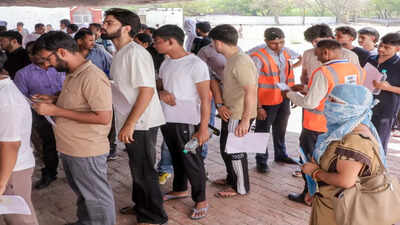
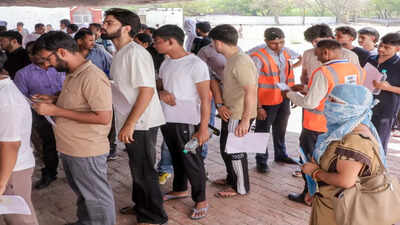
For millions of Indian students, the National Eligibility-cum-Entrance Test (NEET) is not merely an examination. It is a referendum on sacrifice. It is the exam that consumes teenage years, empties family savings, fuels the coaching economy across cities like Kota, Delhi and Sikar, and determines whether a student from a modest household can enter one of the country’s most respected professions. For years, NEET was projected as India’s great meritocratic filter — brutally competitive, emotionally exhausting, but ultimately fair.That belief is now under severe strain. On May 12, the National Testing Agency (NTA) announced that NEET-UG 2026, conducted on May 3 for nearly 24 lakh candidates, would be reconducted after what it described as serious concerns arising from multiple inquiries into the alleged circulation of question sets before the examination.According to the agency’s statement, inputs from Rajasthan and Uttarakhand referred to question sets allegedly circulated in advance, portions of which were later found to bear “significant overlap” with the actual NEET paper. The NTA said the material available with it, examined in coordination with central agencies and law-enforcement authorities, did not permit the continuation of the existing examination process “without compromising the standards of fairness and public confidence.”The Government of India has now handed over the matter to the Central Bureau of Investigation (CBI) for a comprehensive inquiry. The country is once again confronting allegations surrounding the integrity of one of its most consequential national examinations barely two years after the massive NEET-UG 2024 scandal shook public confidence.
A familiar national crisis returns
The latest developments suggest that investigators are examining what may have been a coordinated pre-examination circulation network spanning multiple states.According to the NTA statement, investigators linked to the Rajasthan Police Special Operations Group examined a question bank containing more than 400 questions allegedly circulated days before the examination. More than 100 biology and chemistry questions reportedly showed substantial similarity with questions appearing in the final NEET paper.Searches and inquiries were subsequently conducted across locations in Rajasthan, including Sikar, and in Dehradun. Certain coaching operators and intermediaries have also reportedly come under scrutiny. Parallel material allegedly linked to a coaching academy in Latur, Maharashtra, also surfaced, though local authorities stated that no formal investigation had begun there at the time.The agency has acknowledged that reconducting the examination will impose “substantial inconvenience” on candidates and families. Yet it argued that preserving “institutional credibility and public trust” left no lesser alternative.That phrase may ultimately define the entire controversy. Because the real issue before India is no longer simply whether a paper was leaked. It is whether young Indians still believe the system is capable of fairness.
The shadow of 2024 still looms large
The 2026 controversy arrives in the long shadow of the NEET-UG 2024 scandal, which triggered nationwide outrage, Supreme Court hearings, arrests, and a CBI investigation into alleged organised leak networks.In 2024, investigators alleged that question papers had been accessed before the examination through coordinated networks operating across Bihar and Jharkhand. Reports at the time described solver gangs, burnt paper fragments, digital circulation of question papers, and candidates allegedly paying enormous sums for access to leaked material.The Central Bureau of Investigation later informed the Supreme Court that the leak had allegedly originated from Oasis Public School in Hazaribagh, where accused individuals were suspected of opening sealed paper packets, photographing question papers, and resealing them before distribution.The Supreme Court ultimately declined to cancel the examination nationwide, observing that there was insufficient evidence of a system-wide breach large enough to invalidate the entire process. Yet the court acknowledged that leaks and malpractice had indeed occurred.The country was assured that reforms, monitoring mechanisms, and stronger safeguards would follow. Yet two years later, India is once again debating whether one of its largest examinations can be trusted.
Not only NEET, scandals like NET also shook the nation
The recurring controversies are no longer confined to NEET alone. Over the past few years, multiple high-stakes examinations across India have faced allegations of leaks, irregularities, or compromised integrity. In 2024, the Union Education Ministry cancelled the UGC-NET examination just a day after it was conducted following inputs that the integrity of the examination “may have been compromised,” leading to a CBI investigation. The same year, the Uttar Pradesh Police constable recruitment examination was scrapped after paper leak allegations triggered widespread protests among nearly 48 lakh candidates. The shadow of the infamous Vyapam Scam — involving manipulated entrance tests, recruitment fraud, impersonation rackets, and organised corruption networks — still looms over India’s examination system even a decade later. Together, these incidents are reinforcing a dangerous public perception: that examination malpractice in India is no longer episodic, but increasingly systemic.
The real casualty is trust
Every year, lakhs of students structure their lives around NEET. Teenagers isolate themselves socially, study for relentless hours, move to coaching hubs, and place enormous emotional pressure upon themselves. Parents drain savings, mortgage security, and invest years into a single examination that promises mobility and opportunity. When allegations of leaks emerge, students do not merely fear unfair rank inflation.They fear betrayal.And betrayal carries consequences far beyond a single examination cycle. Repeated controversies create something far more corrosive than administrative embarrassment. They create generational distrust. Students begin questioning whether effort still matters.Whether honesty is becoming a disadvantage. Whether access, money, and networks are slowly overpowering merit. That erosion of belief may be the most dangerous outcome of all.
India’s exam economy and the rise of organised malpractice
The NEET controversy also exposes a larger structural crisis within India’s hyper-competitive examination ecosystem. Competitive examinations today are no longer isolated academic exercises. They are part of a massive parallel economy involving coaching institutes, digital test-series platforms, intermediaries, private hostel systems, and information networks operating across states.Most coaching institutions function legitimately. But the ecosystem surrounding high-stakes examinations has increasingly become vulnerable to exploitative practices, leaked material rackets, fraudulent claims, and organised manipulation.The allegations now being examined in Rajasthan, Uttarakhand, and other states suggest that malpractice itself may be evolving into a sophisticated industry.That should deeply alarm policymakers. Because once cheating becomes systematised, merit becomes destabilised. And once merit loses credibility, institutions lose moral authority.
Beyond NEET: A wider institutional warning
India’s repeated examination scandals are no longer isolated incidents. Over the past several years, recruitment examinations, eligibility tests, constable examinations, and public service commission papers across states have repeatedly faced allegations of leaks, irregularities, or organised fraud.Each scandal leaves behind more than cancelled papers and arrests. It leaves behind public cynicism. A nation cannot repeatedly tell its youth that education is the path to dignity while simultaneously failing to protect the credibility of the systems governing that education.India often speaks proudly about its demographic dividend, its vast young population. But demographic strength can quickly transform into democratic frustration if institutions repeatedly fail the young citizens who depend on them.
Are we moving backwards?
India today possesses more technological infrastructure, digital surveillance systems, cybersecurity tools, and administrative capacity than at any point in its history.Yet paper leak controversies continue to return with alarming frequency.That contradiction is difficult to ignore. The tragedy of NEET 2026 is not merely that another examination may have been compromised. The deeper tragedy is that millions of students are beginning to view such controversies as inevitable. And when a society normalises distrust in merit, the consequences spread far beyond examination halls. They enter public life, governance, and professional ethics.The question before India is no longer only whether another paper leak occurred. The larger question is this: If the country cannot guarantee fairness in examinations that determine the futures of millions, what exactly does merit mean anymore?